


The basic principle
As a member of Borgo Batone, you make a one-off payment which is converted into credits known as ‘Batonis’. You can use these to holiday in the village. Whether you’d like to come with friends or your extended family, the village offers every opportunity. And if you ever decide not to take your holiday in Tuscany, you can pass the Batonis on to friends and family. The Borgo is also the ideal place for focused work, organising seminars and cultural events. On every visit, you’ll encounter both new and familiar faces. So every stay at home in Tuscany is always different.
Even when we’re not on site, we’re still connected: the community remains present in the circles where we take care of necessary tasks and continue to develop the village, in the work camps, at the Community Days, or in the regional groups.

BECOME A MEMBER
Would you like to be part of a vibrant village, help shape community life and build a culture of hospitality? A warm welcome to Borgo Batone!
In 2026, we’ll be opening our doors once again to a handful of new members. Sign up for one of our upcoming info calls and get to know us better.
11 May 2026 (5pm)
22 June 2026 (6.30pm)
Registration HERE

THE LOCATION IN TUSCANY
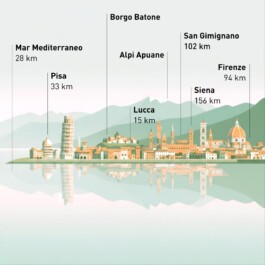
Borgo Batone is situated in northern Tuscany on a hilltop, surrounded by woodland and olive groves in the Apuan Alps. From here, there are sweeping views across the valley. Lucca is 20 minutes away – a cultural city with Renaissance city walls, a picturesque old town, a wide variety of restaurants, cultural attractions and weekly markets. The beaches of Viareggio and Forte dei Marmi are 30 minutes away. Florence is 1.5 hours away. The village can be reached by train and bus, by car and bicycle, or via Pisa Airport.
The true quality of this location: Borgo Batone lies at the intersection of culture and tranquillity. Close enough to civilisation not to feel isolated. Far enough away to preserve peace and authenticity. People come here because they can work here – remote meetings in the morning, a siesta at midday, shared meals in the evening. The location is pure quality of life.

A VILLAGE STEEPED IN HISTORY
Borgo Batone may well have been named after a Roman legionnaire called Bato – which opens the door to a 2,000-year history. Most of the 17 buildings date from the late Middle Ages and the Renaissance. For centuries, the land was farmed and wine and olives were grown. People lived and worked here, shaping Borgo Batone over the centuries.
From the 1960s onwards, people began to leave the village. The young people moved to the cities and the older generation passed away. The village became deserted. Houses fell into disrepair. Roofs began to leak. Windows shattered. Just as in many Italian mountain regions. Since 2021, life has been returning and the village’s future is being written a little further every day.


SEVENTEEN HOUSES
The village comprises 17 buildings with a potential of around 2,000 square metres of living space. Part of this is currently available for use as communal living space. In addition, there are 25 hectares of land – consisting of woodland and olive groves. Greenery as far as the eye can see.
The heart of the village is the 16th-century ‘Villa Barsotti’, a typical Lucchese villa. It has been restored with a keen sense of space and time. A park-like garden with a swimming pool, shared by everyone, adjoins the villa. Surrounded by fruit trees, roses and olive groves, with vine-covered pergolas and a vegetable garden, there is a spot for everyone here.
The architecture is authentically Tuscan: rubble stone, terracotta roofs. Some houses stand alone, others are semi-detached. There are private terraces and shared spaces. A mature village with a variety of spaces and living environments.
VILLA BARSOTTI
The most striking building in the village is Villa Barsotti, a 16th-century Italian manor house. With its high ceilings, large windows and central hall, Villa Barsotti is the heart of community life.
Upon entering through the yellow double doors, you'll find yourself directly in the great hall – convivial meals take place at the long table, whilst in the kitchen, cooking and chatting flow seamlessly into one another. In the fireplace room, people gather cosily during the cooler months. The upper floors contain several bedrooms. The windows offer views over the park and into the valley.
Villa Barsotti is the place where the community lives and breathes. This is where meals are shared. This is where plans for the future are discussed. This is where friendships are formed.


